Showing posts with label 2010. Show all posts

Friday, August 10, 2012

It's a Book by Lane Smith


It's a Book

Smith, L.  (2010).  It’s a Book.  New York City, NY: Roaring Book Press.  ISBN: 978-1-59643-606-0.

Annotation
In this digital age, a Monkey, Jackass, and a mouse make a bold message about technology and books.

My thoughts
I thought that this book would be too simplistic, but after reading it I’ve decided that it is a good way to promote books to younger tech happy generations. This story pokes fun at the tragic outcome of the technological era as the jackass is unable to grasp the simplistic beauty of books. This book, however, might not be appropriate for classroom settings since ‘jackass’ might be offensive to some people. This would be a good book for library displays for Banned Books Month or humorous picture books.

Literary devices
Use of Repetition: “It’s a book.” Is repeated numerous times.

Reading level/ Interest Age
Ages 6-10 (older readers will find this story humorous).

Reviews and Awards
IRA Children’s Choices, 2011
NY Times Notable Children’s Books, 2010
Goodreads Choice Award for Picture Book, 2010

Author website: http://www.lanesmithbooks.com
Media: Oil paint and ink
Genre: Juvenile picture book

Tuesday, July 31, 2012

The Buffalo Are Back by Jean Craighead George and Wendell Minor

The Buffalo Are Back


George, J. C., & Minor, W. (2010). The Buffalo Are Back. New York: Dutton Children's Books. ISBN: 978-1430109785.

Annotation
Jean Craighead George’s picture book that details the almost eradication of the buffalo and how that effected the plains Indians and the near destruction of the Great Plains environment.

My thoughts
"In the mid-1800s seventy five million buffalo roamed in North America. In little more than fifty years, there would be almost none." “What happened? The answer is a story of the American Indians, the buffalo, and the grass.”

In The Buffalo Are Back, Jean Craighead George (Julie of the Wolves and The Wolves Are Back) explains in detail the historical events that lead these majestic animals to the edge of extinction. In a very clear narration, the reader is taken back through an eco-history of the Great Plains. The journey begins in the 1800s with the birth of a single orange buffalo then tells the story of the Native Americans/Plains Indians, the white fur hunters, and westward expansion. In a mere fifty years, the Great Plains was an environmental disaster. 

This is a great book to use for discussing the environment and ecology. This is the story of not only the rescue of the buffalo and Great Plains but also the history of American Conservationism with a very important message.

Curricular connections
Subjects: History, Science/Ecology, Biology/Life Sciences, Science/ endangered species, History/environmental history, Biology/environmental issues.
Grade: 5-12

Literary devices
Use of Simile:
"A lark flew to the top of a six-foot blade of grass and sang as sweetly as a panpipe".
"The green-gold grasses of the plains rippled like waves from horizon to horizon.

Use of Repetition:
"A lark flew to the top of a six-foot blade of grass and sang as sweetly as a panpipe"(2). “A lark flew to a blade of grass and and as sweetly as a panpipe.” (17) "A lark flew to the top of a six-foot blade of grass and sang as sweetly as a panpipe." (27)

Reading level/ Interest Age
Grade 3 and up.

Reviews and Awards
Junior Library Guild Selection
Teacher’s Choice Award / Intermediate Readers, 2011
National Science Teachers Association (NSTA) Outstanding Science Trade Books for Students K-12 2011 (Books published in 2010) Life Science division

Author website: http://www.jeancraigheadgeorge.com/
Illustrator website: www.minorart.com/
Media: Watercolors (based on photographs taken by Charlie Craighead and Thomas D. Mangelsen).
Genre: Nonfiction

Monday, July 30, 2012

The Extraordinary Mark Twain (According to Susy) by Barbara Kerley and Edwin Fotheringham


The Extraordinary Mark Twain (According To Susy)

Kerley, Barbara, & Fotheringham, Edwin. (2010). The Extraordinary Mark Twain (According to Susy). New York: Scholastic Press. ISBN: 978-0-545-125086.

Annotation
Based on thirteen year-old Susy Clemens’ secret biography of her famous writer father Samuel Clemens (aka Mark Twain).

My thoughts
Barbara Kerley shows a side of Mark Twain by using quotes from Susy Clemens’ journal. The book tells about Twain’s family and personal life and interspersed are Susy’s comments about her father. It starts off with Susy stating that most people don’t really know Mark Twain and that he was so much more than a humorist. Susy proceeds to describe her father. She writes about his flaws (smoking too much), his likes (billards), makes observations about his temperament, and describes his physical appearance. Susy gives the reader an honest account of one of America’s greatest writers.

Edwin Fotheringham’s bright glossy digital illustrations add humor and details that bring the reader back to Twain’s time. The illustrations support the text without distracting the reader. The journal “mini-book” pages inserted between the pages written with cursive with the misspelling of youth give insight and make this a good example of primary and secondary sources.

The book includes a timeless of Mark Twain’s life in the back along with instructions about how to write a biography.

Curricular connections
Elementary school 5th grade- Middle school: Humanities/English: biographies

Using the page in the book, Writing an Extraordinary Biography (According to Barbara Kerley*), as a guide for students to learn how to write a biography. Then have them write a biography on someone who they know well utilizing observation, research, examples and quotations, and specific details. Students can use the mini-diary for inspiration.


Lesson Plan
See 'Lesson Plan' page

Literary devices
Use of Alliteration:
“the busiest bee in the household hive”

Use of Repetition
The cursive line work in the background of the illustrations which seem to represent Mark Twain's verbose nature and remind the reader that this is a story told from a young perspective. 

Reading level/ Interest Age
Grade 3-6

Reviews and Awards
2010 CYBILS Nonfiction Picture Book Award
NCTE Orbis Pictus Recommended Book
Best Children’s Books 2010 -- Publishers Weekly
Best Books 2010 -- School Library Journal
Best Books for Children and Teens 2010 -- Kirkus Reviews
Best of 2010: Books for Young Readers -- Washington Post
Oregon Book Award Finalist
Texas Bluebonnet Award nominee

Author website: www.barbarakerley.com/
Illustrator website: www.edfotheringham.com/
Media: digital media
Genre: Juvenile fiction, biography

Sunday, July 29, 2012

Sit-In: How Four Friends Stood Up By Sitting Down.


Sit-In: How Four Friends Stood Up by Sitting Down

Andrea Davis Pinkney and Brian Pinkney, illustrator (2010).  Sit-In: How Four Friends Stood Up By Sitting Down.  New York City, NY: Little, Brown and Company.  ISBN: 978-0-316-07016-4

Author website: No website found.

Ilustrator website: http://www.brianpinkney.net/
Media: watercolor and india ink
Genre: biography, non-fiction, juvenile literature, civil rights movement, history

Annotation
Four African American students in Greensboro (NC) peacefully refuse to leave Woolworth’s lunch counter that only served white people. Their peaceful nonviolent act would inspire others to follow and led to more sit-ins and the end of segregation.

My thoughts
Many have said ‘this is a powerful book’ and it really is. Based on true events that happened in Greensboro in 1960, this book serves as a pictorial representation of a pivotal turning point in our country’s social history. Sit-in: How Four Friends Stood up by Sitting Down is also is a good representative for the power of a good picture book. The storyline, quotes, comments, and illustrates all combine to make this a great multicultural picture book that showcases the Civil Rights and the struggle for equality of the 1960s.

Andrea Davis Pinkney takes this great event and through the personal perspectives of the teenagers and storyline she makes it come alive and become more relatable for children and teens. The book effectively demonstrates the power of people when they work together for a cause that is right inspired by Reverend Martin Luther King, Jr. Actual quotes from Dr. King's speeches within the text to help explain the protesters motivation to keep peaceful. These teenagers sat at a counter and asked for a simple doughnut and coffee. This was a peaceful sit-in for justice and equality not a complex revolution or a political scheme.

The watercolors by Brian Pinkney come across as modern and classic. They added to the story and did not distract from the powerful words and storyline.

The food metaphor and the story really hits you in the gut. Typically, the Civil Rights Movement is one that young people have trouble relating to because of its complexity, but stories such as this really help bring it to life. I also really enjoyed the back of the book's Civil Rights Timeline (in paragraph form from 1954 to 1964), the photograph of the "Greensboro Four" in Woolworth's, the more in depth look at the incident and the times, and additional recommended book and website resources. These 40 pages are really packed with information!

Memorable Reverend Martin Luther King, Jr.’s quotes.
“We must meed violence with nonviolence.”
“Demonstrate… calm dignity.”
“We are all leaders.”
“We must… must meet hate with love.”
“Be loving enough to absorb evil.”

Other memorable quotes:
“They sat straight and proud. And waited. And wanted. A doughnut and coffee, with cream on the side.”
“Practicing peace while other showed hatred was tougher than any school test.”
“… it’s not about food – it’s about pride.”

Curricular connections
This material can be added into a Civil Rights Lesson plan for History and Social Studies (grade 4-6). Both the words and art can be added to a discussion.

Literary devices
Use of Metaphor: The recipe for equality and integration throughout the book.
Use of Repetition: “They did not need menus. Their order was simple. A doughnut and coffee, with cream on the side.”

Reading level/ Interest Age
Grades 4-6

Reviews and Awards
Jane Addams Honor Book (Awards)
Booklist Starred Review
School Library Journal Starred Review

Wednesday, July 25, 2012

Dante's Divine Comedy by Seymour Chwast


Dante's Divine Comedy

Chwast, Seymour. (2010). Dante's Divine Comedy. New York: Bloomsbury. ISBN: 978-1608190843.

Annotation
Dante’s Divine Comedy is Seymour Chwast’s graphic adaptation of the classic, allegorical epic poem written in three parts: Inferno, Purgatory, and Paradise.

My thoughts
This is a much lighter version of Dante Alighieri’s Divine Comedy. The original 14th century allegorical masterpiece has over 100 cantos chronicling a journey through hell, purgatory and paradise. The original poem is intended to be horrifying and is supposed to give a basic education of Christian theology. Chwast’s graphic adaption is much easier to stomach and the summarization takes the text slightly away from the Christian theology making it more entertaining than dogmatic. Overall, this is a good introduction that is amusing and not overwhelming.

In addition, Chwast’s summarization takes away the original poetry that can be up to over 900 pages and condenses the text to 128 pages. The poetry is not as lyrical and has been so summarized that it has been lost so this book might not be good if the intent is for poetry. Then again, many readers shy away from the text because of the poetry. This is a good version to recommend to those who do not enjoy poetry or might not want to read the religious version. The historical names (Euclid, Aristotole, Socrates, Plato, Aeneas, Soloman, etc.), religious figures (St. James, St. John, St. Peter, Adam, Moses, St. Anne, St. Lucy, etc.), canto numbers, key terms (gate of Dis, the river Acheron, etc.) and religious concepts remain the same.

Focus on Artwork
The illustrations are appealing whereas other versions (like William Blake and Dore’s) can be horrifying for readers. I remember my own dismay reading this at a very young age. The illustrations scared me. They still do. These illustrations are humorous and modern. Dante is illustrated like a 1930s Dick Tracy sunglass wearing sleuth-like individual and Vigil wears a bowlers hat and bow tie. The way that these two figures are illustrated make this historically fear-mongering piece of literature less intimidating. This graphic novel version balances out the original Divine Comedy and can be used to modernize the teachings and reading of this western literature classic. 


Curricular connections
High school: Religious Studies, Catholic Dogma, or English.

Literary devices
Use of Sophisticated Language: gluttony, usurers, abstain self-indulgences, wanton, sower of discord, and other terms related to the religious poem.

Use of Allegory: Dante's journey through the levels of inferno, purgatory, paradise is an allegory for the soul’s journey to God.

Reading level/ Interest Age
Grade 7- High school and up: due to mature themes. Hell, inferno, purgatory and the various punishments for sinners aren’t really good for young minds. This is a classic, however, and these illustrations are less intense than William Blake, Dore, or other illustrated texts.

Reviews and Awards
Starred review, Publisher’s Weekly           

Author website: www.pushpininc.com/
Media: ink
Genre: graphic novel

Tuesday, July 24, 2012

Ubiquitous by Joyce Sidman and Beckie Prange


Ubiquitous: Celebrating Nature's Survivors

Sidman, J., & Prange, B. (2010). Ubiquitous: Celebrating Nature's Survivors. Boston [Mass.: Houghton Mifflin Books for Children. ISBN: 0618717196.

Annotation
Joyce Sidman combines poetry and science to examine some of the oldest living evolutionary survivors on Earth. Ubiquitous celebrates these survivors’ unique traits.

My thoughts
Ubiquitous means “somewhere that is (or seems to be) everywhere at the same time. Given that these species are prevalent and exist all over the world many of them are overlooked or assumed to be simple. This book reveals that these prevalent species are anything but simple. They are survivors for certain reasons and while this may seem mysterious, Joyce Sidman writes about some of the unique traits of these species that have made it easier for these species to survive.

This book highlights these special adaptive species and celebrates their unique traits for informational blocks, poetry, and detailed illustrations. Key pieces of information make this book interesting for children for example“…it is said that industrious squirrels plant more trees than humans do.” Crows have been “observed dropping large nuts at highway intersections so that passing cars will crack them open!” “Geckos can literally break their tail in two to escape from predators.”

The timeline in the beginning of the book is probably one of the better Earth timelines that I’ve seen for awhile. It really puts time into perspective. A mass of lines wind around each other like a giant fingerprint and spread across the inside cover and title page. For the scale, each centimeter represents one million years. It begins with Earth’s birth at 4.6 billion years. Humans, only come into the picture at the end of the timeline.

The prints are also creative and appropriate. Everything blends seamlessly.


 These are an impressive set of poems that tribute our planet’s survivors.

Curricular connections
Elementary school science- Biology
Students can reenact this timeline and bring their own timeline into the class using a 46 meters long string and cards to label the key events. Different colored string can be tied together to represent the different geologic periods.

Lesson Plan
See 'Lesson Plan' page

Literary devices
Use of Rhythm
First Life
(a diamante)
Bacteria
Ancient, tiny
Teeming, mixing, melding
Strands curled like ghostly hands
Winking, waving, waking
First, miraculous life
Use of Allusion
“… I am Sheath-wing, beloved of ancients. You have never seen armor like mine. As the sun-god rolls his blazing disk overheard, so I roll my perfect sphere of dung across the sands.” – Alluding to the Egyptians and the Sun-God Ra.

“Who swirled your whorls and ridges? Was it the shy gray wizard shuttered inside you? I hear he walks on one foot and wears a magic mantle, trailing stars. O shell, if only I could shrink! I’d climb your bristled back, slide down the spiral of your heart. I’d knock on your tiny door and ask to meet the mollusk that made you.”

Use of Sophisticated language
Adaptability, diamante, diverse, mutate, photosynthesis, prolific, organism, ubiquitous.

Reading level/ Interest Age
Age 6 and up.

Reviews and Awards
Awards and Honors: Starred reviews in Booklist, Publishers Weekly, School Library Journal, Kirkus, Horn Book; Junior Library Guild Selection; Publisher's Weekly, Best Books of the Year; Washington Post, Best Books of the Year; Kirkus, Best Books of the Year; School Library Journal, Best Books of the Year; National Science Teachers Association/Children's Book Council, Outstanding Science Trade Books, K-12, 2011; Boston Globe, Top Ten Children's Books of 2010; New York Public Library's "100 Best Books"; Booklist, Top 10 Sci-Tech for Youth; Book Links, Lasting Connections for 2010; Finalist for the 2011 CYBILS Poetry Award; Association for Library Service to Children Notable Children's Book; The John Burroughs List of Nature Books for Young Readers

Author website: www.joycesidman.com/
Illustrator website: http://www.beckieprange.com/
Media: linocuts, hand-colored with watercolor
Genre: nonfiction, poetry

Wednesday, July 18, 2012

Skim by Mariko Tamaki and Jillian Tamaki

Skim

Tamaki, Mariko – author, & Tamaki, Jillian - illustrator. (2008). Skim. Toronto: Groundwood Books. ISBN: 978-0888997531.

Annotation
Skim, an angst ridden disgruntled bi-racial overweight teenage girl whose parents are separated goes to an all-girls Catholic college-prep high school and attempts to find her identity during this formative time of life in 1993.

My thoughts
Depression, sexuality, spirituality, paganism, suicide, friendship, self-esteem, and first love are all themes within this book. This character is snarky. She practices astrology and Wiccan rituals, eats cookies without guilt, sometimes despises her supposed best friend, rebels against conformity, and grapples with her emerging gay identity yet she is relatable for many readers both those who are similar and those who are completely different. One reviewer said that, “It was pleasant in that way that quietly unpleasant stories are.” This is how I felt. The book contains difficult issues that show certain heartaches associated with coming of age.

The tale is narrated by Skim’s thoughtful diary. This allows the reader to have insight into the Skim's thoughts and feelings and makes the experience of this book very personal. The diary entries and narrator’s tone seem authentic. The metaphoric entries are a highlight. The character and the situation is so fragile and different. While being about a very 'different' person, the differences weren't shown as... differences. They felt normal. Painful, relatable, and normal. This is a step forward for those who have been labeled as different. For those who might be lesbian or gay or dealing with identity or racial issues.

The suicide attempt of the character of Katie Matthews and the suicide of her boyfriend who was rumored to be gay are potentially literary trite rubbernecking events but Mariko and Jillian capture these events in a way that draws the reader in without becoming stereotyped or tabloid-ish. This level of respect for the topics and the reader might be one reason for this book’s success.

The way the main character is rendered reminds me of the traditional depiction of women in Japanese woodcarving prints and ink paintings. I haven’t read much Japanese literature (Tales of Genji and modern authors) but I’m assuming that the character is foiled to the traditional. Skim is very westernized (practices of wicca and diet are the most obvious examples). Nonetheless, I liked the black and white style of the illustrations.

However, there were some elements bothered me but I can understand how this book would be popular for teenagers. I guess that it another part of the success. Now that I'm older, sometimes it's easy to think that these issues don't genuinely afflict teenagers. Skim is a reminder that they do and the book offers cautionary optimism. Things work out and fall into place for Skim in the end of the book. She finds a friend that she can better relate to and the heartbreak is out of sight and her heart. Overall, this is a unique coming of age story that tells of a conflicted plight that teenage girls will appreciate.

Reading level/ Interest Age
Grade 10 and up/ age 14 and up.

Reviews and Awards
2008 Governor General's Literary Award Nominee (more)
2008 Ignatz Award for Best Graphic Novel
2008 New York Times Best Illustrated Children’s Books List
2009 Doug Wright Award Winner, Best Book
2009 Eisner award nominee (Best Publication for Teens, Writer, New Graphic Album, Penciller/Inker)
2008 Best of Books of the Year: Publishers Weekly, Quill & Quire
2011 Most Awesome Book, Toms River Library Teen Gay Straight Book Club

Author website: No official author website found.
Illustrator website: http://www.jilliantamaki.com/
Media: ink
Genre: graphic novel,

The Stephen Hawking Story: The Boy Who Turned Disability into the Ability to Embrace the Stars by T.S. Lee


The Stephen Hawking Story
T. S. Lee- author. Chad Walker- translator. The Stephen Hawking Story: The Boy Who Turned Disability into the Ability to Embrace the Stars. Englewood Cliffs, N.J.: Joyful Stories Press, 2009. First printing 2010. ISBN: 978-0-981954295.
Author website: No author website found.
Media: Pen and ink
Genre: Graphic Novel, Biography, Comic, Science

Annotation
Fictionalized manga biography about the genius physicist Stephen Hawking. The comic biography shows on how Hawking survived Lou Gehrig's and worked to become one of the world’s top physicists.

My thoughts
Stephen Hawking is a brilliant man and has striven through a lot of adversity and personal challenges to accomplish all of the things that he has accomplished. Overall, I think that this is a good biography. It kept information simple and did not oversimplify Hawking’s life or ideas. This level, the simple manga comic, makes it so that younger readers can know what Hawking is responsible for and learn about his work on black holes and the secrets of the universe and other highlights of science (like Galileo, Newton, and Einstein). Physicists, however, might cringe at the jump in physics to manga. So far, this book has not had too many reviews so it is difficult to know how actual scientists perceive the science in this graphic novel. It can be noted that the actual details of physics might have otherwise shied younger readers away from Hawking’s achievements and science.

Most the book focuses on how Stephen Hawking coped with being diagnosed with Amyotrophic lateral sclerosis (Lou Gehrig’s disease). He learned in his early twenties that he had this disease and was given a couple of years to live. After the diagnosis and physical paralysis, he went on to get his advanced degrees, publish multiple books and articles (including the pivotal A Brief History of Time), propose many new theories, was appointed Lucasian Professor of Mathematics from Oxford University, and became one of the youngest Fellows of the Royal Society. In 1985 due to pneumonia had had a tracheotomy, which rendered him unable to speak without the aid of a voice synthesizer. Through all of this he continued with his interests about the universe and personal goals. The manga graphic novel starts with his children love for books (and memory for details) and covers these events.

Stephen Hawking has lived more than 40 years since he learned he had the disease. He beat the life-expectancy odd for people with ALS and serves as a role model for ALS patients, others who face adversities, and now also children. In addition, this book takes away mystery around the man who speaks with a voice synthesizer. This graphic novel format makes it so that his differences are not as intimidating or different.

Use of sophisticated language
Amyotrophic lateral sclerosis (Lou Gehrig’s disease), epitome, Einstein’s theory of relativity, universal gravitation, celestial bodies, modern theoretical physics, inertia acceleration, reciprocal actions, singularity theorems, theories, degradation, tracheotomy, voice synthesizer.

Reading level/ Interest Age
Grade 3-8

Reviews
The School Library Journal notes that fictionalized manga biographies are “appealing, but their usefulness is limited by their uneven translations” and made the criticism that statements are “incorrect, unclear, unsupported, and occasionally downright weird.” There are – other biographies in this series. I have not read the other biographies but the Stephen Hawking Story one did not contain too many overt errors. 

Sunday, June 24, 2012

How the Sphinx Got to the Museum by Jessie Hartland

How The Sphinx Got To The Museum
Hartland, Jessie. How the Sphinx got to the Museum. Maplewood, NJ: Blue Apple Books, 2010. Print. ISBN: 978-1609050320.

Annotation

Chorus like description of how the Sphinx of Hatshepsut got to New York City’s Metropolitan Museum of Art.

My thoughts
The San Francisco De Young had a Hatshepsut exhibit some time ago and learned about the infamous Stepson. When I saw this book, I was immediately interested even without knowing what the book was about. It had mention of Hatshepsut and that was enough for me. It did end up as an interesting story about how the Sphinx of Hatshepsut got to the New York Metropolitan Museum of Art. I found it to not be what I expected, but it was an educational cumulative piece that answers the questions that many museum goer’s ask. “How did it get here?” A bonus to the educational function of this book is that it is a great nonfiction read-aloud with its fun chorus and chant like text. Children will enjoy participation with the text and the repetition will help children learn and memorize the who’s and what’s of this piece and museum procurement. Jessie Hartland includes a page of “More History” and a page of “Additional Facts and Figures” to add more information and background to the story of the Sphinx.

Focus on Artwork
Jessie Hartland’s consistent style is childlike and cheerful. The simple pictures allow the readers/listeners to focus on the text. The titles of the people are all uniquely collaged with different font types that add a bit of fun to the repetition. The illustrations look like they have been colored with marker in an expressive manner without focuses on line clarity. The people are illustrated in vague cartoonlike ways and are identifiable by clothing and geographic location.

Literary devices
Use of Repetition: The docent retells the many steps and people who contributed to the sphinx's story each time a new part is introduced in a kind of chorus. “Hatshepsut commissioned, the sculptors sculpted, the priests admired it, and the stepson had it destroyed.” The story continues with it being rediscovered centuries later in a pit by an archaeologist, brought to America, and restored. Each time ending with the start of the sphinx’s story and how it was “ordered by the pharaoh.”

 Use of Rhythm: The chorus of people who helped bring the sphinx is rhythmic like “There Was An Old Lady Who Swallowed a Fly.”

Reading level/ Interest Age
Grade 1 and up.

Reviews and Awards
Starred reviews.

Author website: www.jessiehartland.com/
Media: collage and markers
Genre: Juvenile picture book

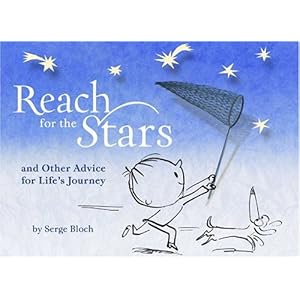
Reach for the Stars: and Other Advice for Life's Journey by Serge Bloch

Reach for the Stars: and Other Advice for Life's Journey
Bloch, S. – author (2010). Reach for the Stars: and Other Advice for Life's Journey. New York: Sterling. ISBN: 978-1402771293.

Annotation
A boy and his dog are given advice in the form of popular and inspirational quotes and euphemisms.

My thoughts
This is an inspirational book that explains the how to handle the good and the bad parts of life with quotes and euphemisms with humorous illustrations. The illustrations in this book make these sometimes weird sounding and popular figure of speech/euphemisms understandable. This is a good concept book for children and will assist in building an optimistic thought process.

The illustrations that incorporate photographs with ink drawings keep this book edgy and humorous.

Literary devices
Use of sayings:
You’re got your whole life ahead of you!
You won’t always be top dog. In fact, sometimes you’ll be in the doghouse.

Reading level/ Interest Age
Preschool and up.

Reviews and Awards
Serge Bloch has won a gold medal at the Society of Illustrators
Horn Book 2010

Author website: www.sergebloch.net
Media: pen and ink drawings with photography
Genre: juvenile picture book


Thursday, June 21, 2012

Mimi's Dada Catifesto by Shelley Jackson


Mimi's Dada Catifesto

Jackson, Shelley. Mimi's Dada Catifesto. New York: Clarion Books, 2009. Print. ISBN: 978-0547126814.

Annotation
This is a picture book about Mimi, an artistic poor alley cat, who has had enough of the street and decides to seek out an artistic human. While doing so, Mimi deconstructs Dadaism and the Dadaists.

The art is one of the things that attracted me to this book. One the cover is a cute orange cat with a moustache bearing a smile close to Mona Lisa’s. The title read Mimi’s Dada Manifest, only with the ‘man’ crossed out of manifesto and replaced with ‘cat’ifesto. The background looks like torn newspaper pieces collaged together and all of the titles letters look like they have been cut from different publications. On the bottom of the cover, two cockroaches dressed to the nines present the author’s name. This is an eye-catching cover.

Introducing the Dadaists to grade school children can be inspiring and fun. In the author’s note, Shelley Jackson writes, “The Dadaists thought it was time to make art just as silly as the real world. They performed nonsense poems. They wore funny costumes. They put ordinary things like neckties and toilets in museums as if they were pieces of art.” These were the artists that colored outside of the lines and really can stimulate young minds to find ways for creative self-expression. I think that many children can resonate with Dadaist art and there are so many art projects that can be done with this book as inspiration (like collage). Along with the author’s note is a list of recommended books and websites and audio CDs that is also useful.

My thoughts
Dadaism was an art movement that is difficult to explain; yet this picture book does a pretty good job of explaining the Dada art movement.

Quotes
“The world was full of silly things in 1915, just like now (umbrellas! bow ties! false teeth!), but most art ignored the silliness. To the Dadaists, that was the silliest thing of all.”

Inside cover “I am not writing this book to get famous/ but to give you some tips on living./ Listen, kiddo: sometimes you stare at a black dot for an hour/ and nothing happens./ But sometimes it gets up and walks across the floor./ I like bugs./ What I’m trying to say is-> Pay attention/ and expect the best.”

Curricular connections
Grades 1-4: Art


Lesson Plan
See 'Lesson Plan' page


Literary devices
Use of Sophisticated language: nuisance, industrial-strength, primitive, Dadaist.

Repetition: “That cat… is a stupendous nuisance. A primitive force of destruction! A steam-powered, industrial-strength…” (Repeated twice).

Simile: “Make like a pet.”

Reading level/ Interest Age
Grade 1-4/ Age 6 and up

Author website: ineradicablestain.com/
Media: Mixed media
Genre: Juvenile picture book