Showing posts with label juvenile. Show all posts

Sunday, July 29, 2012

Sit-In: How Four Friends Stood Up By Sitting Down.


Sit-In: How Four Friends Stood Up by Sitting Down

Andrea Davis Pinkney and Brian Pinkney, illustrator (2010).  Sit-In: How Four Friends Stood Up By Sitting Down.  New York City, NY: Little, Brown and Company.  ISBN: 978-0-316-07016-4

Author website: No website found.

Ilustrator website: http://www.brianpinkney.net/
Media: watercolor and india ink
Genre: biography, non-fiction, juvenile literature, civil rights movement, history

Annotation
Four African American students in Greensboro (NC) peacefully refuse to leave Woolworth’s lunch counter that only served white people. Their peaceful nonviolent act would inspire others to follow and led to more sit-ins and the end of segregation.

My thoughts
Many have said ‘this is a powerful book’ and it really is. Based on true events that happened in Greensboro in 1960, this book serves as a pictorial representation of a pivotal turning point in our country’s social history. Sit-in: How Four Friends Stood up by Sitting Down is also is a good representative for the power of a good picture book. The storyline, quotes, comments, and illustrates all combine to make this a great multicultural picture book that showcases the Civil Rights and the struggle for equality of the 1960s.

Andrea Davis Pinkney takes this great event and through the personal perspectives of the teenagers and storyline she makes it come alive and become more relatable for children and teens. The book effectively demonstrates the power of people when they work together for a cause that is right inspired by Reverend Martin Luther King, Jr. Actual quotes from Dr. King's speeches within the text to help explain the protesters motivation to keep peaceful. These teenagers sat at a counter and asked for a simple doughnut and coffee. This was a peaceful sit-in for justice and equality not a complex revolution or a political scheme.

The watercolors by Brian Pinkney come across as modern and classic. They added to the story and did not distract from the powerful words and storyline.

The food metaphor and the story really hits you in the gut. Typically, the Civil Rights Movement is one that young people have trouble relating to because of its complexity, but stories such as this really help bring it to life. I also really enjoyed the back of the book's Civil Rights Timeline (in paragraph form from 1954 to 1964), the photograph of the "Greensboro Four" in Woolworth's, the more in depth look at the incident and the times, and additional recommended book and website resources. These 40 pages are really packed with information!

Memorable Reverend Martin Luther King, Jr.’s quotes.
“We must meed violence with nonviolence.”
“Demonstrate… calm dignity.”
“We are all leaders.”
“We must… must meet hate with love.”
“Be loving enough to absorb evil.”

Other memorable quotes:
“They sat straight and proud. And waited. And wanted. A doughnut and coffee, with cream on the side.”
“Practicing peace while other showed hatred was tougher than any school test.”
“… it’s not about food – it’s about pride.”

Curricular connections
This material can be added into a Civil Rights Lesson plan for History and Social Studies (grade 4-6). Both the words and art can be added to a discussion.

Literary devices
Use of Metaphor: The recipe for equality and integration throughout the book.
Use of Repetition: “They did not need menus. Their order was simple. A doughnut and coffee, with cream on the side.”

Reading level/ Interest Age
Grades 4-6

Reviews and Awards
Jane Addams Honor Book (Awards)
Booklist Starred Review
School Library Journal Starred Review

Thursday, July 26, 2012

Boys of Steel by Marc Tyler Nobleman and Ross MacDonald


Boys of Steel: The Creators of Superman

Marc Tyler Nobleman, - author. Ross MacDonald - illustrator. Boys of Steel: The Creators of Superman. New York: A.A. Knopf, 2008. ISBN: 978-0-375-8385-02-6.
Author website: http://noblemania.blogspot.tw/
Ilustrator website: http://www.ross-macdonald.com/pages/illusmain.html
Media: ink and watercolor
Genre: juvenile fiction, biography

Annotation
In 1934, during the economic despair of the Depression, two shy teenagers created the original social crusader- Superman. Tells the story of Jerry Siegel and Joe Shuster and the story behind Superman.

My thoughts
“It’s a bird. It’s a plane. It’s Siegel and Shuster!” (quote from book jacket) Based on the true story of the comic book creators, this book disguises a biography book as pop lit but with classic comic illustrations. The author, Nobleman, weaves research seamlessly into the story and maintains an accurate biography. The illustrations mimic Joe Shuster’s original superman style and the general comic style of the 1930s. The choice to illustrate the biography similarly to the original is in this case important for the comic book biography and adds a bit of art history into the picture for juvenile readers.

Boys of Steel does a good job at providing a visual story driven biography for one of the most famous superheroes. The boys met in high school and sold their idea to DC Comics when they were 24 after years of visualization and trying to sell the character. One of the key points that hit me was the idea that Jerry Siegel came up with as his inspiration for Superman. “People wanted a hero they knew would always come home. Jerry and Joe gave them that- the world’s first superhero.”

Nobleman adds important social context that accelerated Superman’s popularity. This was after the decade of the economic despair of the Depression and the brewing war (WWII). “Everyday people were about to be called to duty, and many would prove to be real-life heroes. But if there was ever a time for a fantasy hero, particularly one with powers and abilities far beyond those of mortal men, it was then.” People also needed escape.

The last three pages provide a more advanced look into Superman and the sad part of the story where Siegel and Shuster sell all rights to the character to DC Comics for $130. Nobleman gives a legal history and the rights controversy behind Superman including facts that while Superman made millions the author and illustrator often bordered on poverty.

Curricular connections
This book can be suggested to grade school students writing reports on events and biographies. This is a good book to suggest to children complaining about the typical biography book style (complaining about length, lack of interest, lack of pictures, lack of interest) or say that the reports are boring. Also recommended for comic book fans.

Reading level/ Interest Age
Grade 5 and up (Booklist recommends this books for Grade 1-3)/ Ages 10 and up

Reviews and Awards
Booklist Starred Review
Kirkus Starred Review 2008- "The battle for truth and justice is truly never-ending."
Publisher’s Weekly Starred Review 2008- “Nobleman details this achievement with a zest amplified by MacDonalds -- punchy illustrations.”

Friday, July 20, 2012

The Money We'll Save by Brock Cole


The Money We'll Save

Cole, B. (2011). The money we'll save. New York: Farrar Straus Giroux. ISBN: 978-0374350116.

Annotation
Times are tough in this nineteenth century New York City tenement, so Ma asks Pa to try to save money while grocery shopping. Pa takes her suggestion. He comes home with a baby turkey that’s alive.

My thoughts
Talk about great timing. Illustrated to appear out of the turn of the nineteenth century, this book shows a struggling family making do and living happily with what they have. 

This book has a lot going for it. There is the unique situation of a small New York City tenement with a country turkey. The humorous antics that transpire when trying to keep the pseudo-wild bird in the unnatural captivity of the home. There is the unique text that flows and makes this a great read along for younger audiences. There is the concept of being content in owns environment without falling into over consumerism. (As implied by the family existing on their means without sketching debts to buy the best groceries and appearing happy- Pa doesn’t appear despondent. He makes it work). And finally, there is the art.

More about the book- moral issues of eating animals are implied. This book doesn’t get into depth that but it certainly is implied by the family’s resistance to eating the turkey claiming it would be like eating their neighbor. This would be a nice book for parents, children, teacher’s to use for related discussions. It doesn’t toss out the point and say think about food sources, but it certainly leads the reader down that path of thinking about where the meat comes from.


I highly recommend this book! In fact, it is the new “Christmas Story” (80's movie) of my family.

Reading level/ Interest Age
Editorial reviews suggest that this book is for 4 and up (I would suggest that the up equal older readers and anyone looking for a humorous/holiday picture book).

Reviews and Awards
Horn Book’s Best Picture Books of 2011
Starred reviews

Author website: No website found.
Media: Ink and watercolor.
Genre: holiday, juvenile picture book

Wednesday, July 18, 2012

And Tango Makes Three by Justin Richardson, Peter Parnell, and Henry Cole

And Tango Makes Three

Annotation
Picture book based on a true story of an unordinary penguin family living in New York City’s Central Park Zoo.

My thoughts
Roy and Silo are a couple of two adult male penguins who have changed the way people view penguins social life and penguin partnership. The parental life of penguins are already fascinating, as the males will spend time nesting whilst the female leaves, but this story about Tango and his ‘homosexual’ penguin parents is doubly interesting as a story and zoologically.

Tango’s birth was the result of a strategically placed egg. After the zookeeper noticed Silo and Roy’s multiple attempts to have a hatchling of their own, he place an ‘extra’ egg from another male/female penguin pair and gives it to Roy and Silo. They take care of the egg just as the other heterosexual penguins and Tango is born. This is a heartwarming story.

Banned Book
The American Library Association reports that And Tango Makes Three was the most challenged book of 2006 to 2010, except for 2009 when it was the second most challenged. Even though this is an account of a true animal story, there are school districts and parents around the country who are protesting this book and having it banned from school libraries due to the nature of the penguin's relationship in the book.

It’s a far off cry to take this book and try to make implications for it to be banned. This issue is one that should not be mixed with this light real life story about Roy, Silo, and Tango. The controversy of homosexuality and legal rights of marriage is a recent controversy and has become a complicated issue. The more complicated debates belong in different forums and shouldn’t be mixed with this sweet picture book.

Reading level/ Interest Age
PreSchool-Grade 3

Reviews and Awards
National book awards
American Library Association Notable Children's Book - 2006
ASPCA's Henry Bergh Award - 2005
Gustavus Myer Outstanding Book Award- 2006
Nick Jr. Family Magazine Best Book of the Year - 2006
Bank Street Best Book of the Year - 2006
Cooperative Children's Book Council Choice, and CBC/NCSS Notable Social Studies Trade Book - 2006
Lambda Literary Award finalist - 2006
Sheffield Children's Book Award - shortlisted – 2008
Other awards from children's groups

Author website: No websites found.
Illustrator website: www.henrycole.net/
Media:
Genre: juvenile picture book, juvenile

Monday, July 9, 2012

Rose Blanche by Christophe Gallaz and Roberto Innocenti.


Rose Blanche
Gallaz, Christophe, and Roberto Innocenti. Rose Blanche. Mankato, Minn.: Creative Editions, 1985. Print. ISBN: 978-2921620802.
Author website: No website found.
Illustrator website: http://www.robertoinnocenti.com/
Media: oil paint
Genre: juvenile fiction, historical fiction

Annotation
Rose Blanche is fictional story about a German schoolgirl risking her life to secretly bring food to the imprisoned children in a nearby Nazi concentration camp.

Summary
Rose Blanche follows a group of Nazi soldiers after they arrest a fleeing boy and discovers a concentration camp. After seeing the imprisoned children, Rose tried to help by taking food to the camp daily until the town is liberated. Tragically, on the same day as the liberation, Rose travels to the concentration camp to bring food to the children and is deeply saddened to discover that the camp is gone. At this point, through the fog, “there was a shot.” Rose Blanche is killed by an allied bullet in the end.
 

My thoughts
Rose Blanche honestly depicts the atrocities of war. Because this is a story about World War II from the perspective of a young girl, the author does not provide historical details and doesn’t explain many things in the story. The effect of capturing the viewpoint of a young girl who does not completely understand the war is very effective. Most people usually do not understand what occurs during wars. Innocenti and Gallaz leave the reader intentionally unenlightened during many parts of the book to reinforce this feeling of limited knowledge.

Key concepts such as Nazi, Swasticka, Holocaust, Jewish, concentration camp, are also not mentioned but are descriptively shown in the illustrations. The tragedies of the Holocaust are expressed through imagery and limited language leaving the reader to follow visual cues and graphic allusions to the concluding events. This method of leaving symbols and events seen but wordless and unexplained is really a horrifying concept. These are unexplained tragedies, ruthless savagery, and horrifying monstrosities, but to Rose Blanche it is simple: she must help the children.

There is so much unspoken but implied in this book that will make it more appropriate for a mature audience. Then there is the disappearance of the children and Rose’s own death which was the result of a careless mistake. Even the final liberation is also not understood by the young child. Soldiers enter the town and are identified in the text as ‘speaking another language and wearing different uniforms.’ This book does an excellent job at bringing the experience alive but the reader should have a basic understanding of the war.

Innocenti’s powerful and very realistic paintings are amazing. These illustrations are what captured my attention when I was trying to decide on a book for this genre.

Banned Book
This is considered a controversial picture book. This is partially because of its graphic nature and mature content. This book truly captures the true horror of war and the feeling of being helpless. That is something that should not be banned. I do feel that teachers should teach the material to bring a complete understanding to young children to get the full picture. In addition, librarians should use discretion and should suggest this book for older readers already familiar with the Holocaust and World War II. But I don’t think that it should be censored or re-edited from the original text. Many things should be challenged, the Holocaust was a terrible event that many would like to forget. It is, however, important to keep younger generations educated and aware of these events and perspectives. Rose Blanche provides a springboard for discussion and allows children find a viewpoint that will in turn change their own. Hopefully, through witnessing Rose’s perspective young readers will become empowered. 


Literary devices
Use of symbolism: The main character is named after the "Rose Blanche" (or the French White Rose) was a group of young German protestors that were executed for their resistance to the war.

Curricular connections
Social Studies grade 4-8  (Holocaust, World War II, European front)
Humanities grade 4-8 (Discussion: historical fiction and narrative shifts)

Reading level/ Interest Age
There is controversy surrounding this book due to it graphic nature and deep topics. Because of this controversy and mature discussions (the Holocaust and Rose’s death), I would recommend this book for older students rather than elementary students.

Reviews and Awards
Roberto Innocenti received the Hans Christian Andersen Medal for Illustration, 2008
Mildred L. Batchelder Award, 1986. This award is given to an American publisher for an outstanding children's book that was originally published in a foreign country in another language.
Golden Apple, Biennale of Illustrators, Bratislava, 1985
American Library Association Notable Book, 1986
Boston Globe Horn Book Honor Book citation, 1986

Anne Frank by Josephine Poole and Angela Barrett


Anne Frank


Poole, Josephine. (2005) Anne Frank. Illustrations by Angela Barrett. Alfred A. Knopf, New York, NY. ISBN: 978-1-60060-439-3
Author website: No website found.
Ilustrator website: No website found.
Media: drawn and painted
Genre: Juvenile literature, biography, history

Annotation
Meticulously researched visual narrative picture book that captures the beautifully inspirational moments along with the haunting and horrifying times of Anne Frank’s life.

My thoughts
Anne Frank’s story is told simply but in no means is it simple. The story begins “with an ordinary little girl, someone you might sit next to in class” and proceeds from her birth in Frankfurt (1929) to being discovered by the Nazi’s in the attic, to the posthumous discovery of her diary after World War II. Many facts about the social conditions and social transitions are effectively communicated by visually and through the text.

Focus on the artwork
The illustrations really make this book special. In an interview by Magic Pencil, Angela Barrett discusses the research that went into creating the illustrations. She states that it was important to get all the details correct and she kept in mind that there are people alive who remember those details. She aimed for historically authenticity and incorporated symbolism into both her technique and the elements within the illustrations. “Things matter and the way people persecute you is they take the things away from you.” The transition from wealth to disparity is represented in the book by showing in the beginning that the family did have beautiful things to the end where Anne and Peter sit side by side with basically nothing…. just each other.

Additionally and very importantly, are the emotional elements that are depicted within the representation of the character of Anne Frank. From photographs, Bennett seems to capture her likeness. The last picture of the Anne’s nightmarish apprehension by the Nazi’s is haunting and full of emotional punch. Her eyes look out from the page affixed to the helpless reader but her lips are pressed tightly together. It seems to be a wordless cry out to the reader.

Oddly, for this genre and topic, the book presents a great deal of information in a very manageable way making it a good book to be further deconstructed and discussed. This is an easy-to-understand introduction to the Holocaust.

Quotes
“There was a man called Hitler- a stiff little man with a mustache- he talked a lot and made big promises. Huge crowds gathered round him. They had no jobs, no hope. No wonder they cheered when he promised to make Germany rich and strong again.”

This point can be added into a discussion to understand what was going on with the Germans during this period. Many people can’t understand how they would allow such atrocities to occur. These simple sentences provide a rationale that young audiences can understand and can be added into the discussion in addition to racism and prejudices that brought forth the genocide of the Holocausts. Many times historical events can be broken down to economic foundations.

Curricular connections
History 6th or 7th grade- provides Anne’s Frank’s personal perspective in a visual narrative. This book can accompany the literary classic The Diary of a Young Girl by Anne Frank.

Reading level/ Interest Age
Grade 4-7 Grade level 3-5?

Reviews and Awards
Booklist Starred Review
School Library Journal Starred Review

Interview-
http://www.bl.uk/onlinegallery/features/magicpencil/learning_barrett_interview_4.html

Saturday, June 30, 2012

Mirror Mirror: A Book of Reversible Verse by Marilyn Singer and Josee Masse


Mirror Mirror: A Book of Reversible Verse

Singer, M., & Masse, J. (2010). Mirror Mirror: A Book of Reversible Verse. New York, N.Y.: Dutton Children's Books. ISBN: 978-0525479017.

Annotation
A picture book of reversible poems based on popular fairytales that includes different perspectives from the main character and villain using the same words.

My thoughts
Talk about misunderstanding someone’s words. It’s fascinating how the same words, the same poem, can be written in the opposite direction to give a new meaning and different tone. The only changes are capitalization and punctuation, but the points of view and perspective are entirely different. This book is a clever turn on words and an interesting word play with familiar characters from childhood fairytales. And, it makes an individual think about word order and perspective. The book truly shows that there are two different sides to the story and entire picture.

Curricular connections
Humanities- poetry grades 2-6: Recommended for readers who enjoy poetry and playing with words, lovers of fairy tales, teachers who teach writing (or poetry/fairy tales), or anyone who loves children’s books.


Lesson Plan
See 'Lesson Plan' page

Reading level/ Interest Age
Grades 2-6

Reviews and Awards
2011 ALA Notable Children’s Books, All Ages; 2011 NCTE Notable Children's Books in the Language Arts; CLA Notable Children's Books in the English Language Arts 2011; Children's Book Committee Bank Street College of Education Children's Choices - Best Books of 2011, Special Interests, Poetry; Booklist 2010 Editor’s Choice, Books for Youth, Nonfiction, Middle Readers; Booklist Lasting Connections of 2010, Language Arts; Horn Book Fanfare, Best Books of 2010, Poetry; Kirkus Reviews 2010 Best Children’s Books; Publishers Weekly Best Children’s Books 2010, Picture Books

"The poems are both cleverly constructed and insightful...giving us the points of view of characters rarely considered." --Horn Book

"A mesmerizing and seamless celebration of language, imagery, and perspective." --Kirkus, starred review

Author website: marilynsinger.net/
Illustrator website:  www.joseemasse.com/
Media: acrylic paint on illustration board
Genre: poetry

Thursday, June 28, 2012

The Composer is Dead by Lemony Snicket and Carson Ellis


Snicket, Lemony – author, Carson Ellis - illustrator, and Nathaniel Stookey -. music The composer is dead. New York: HarperCollins, 2009. ISBN: 978-0061236273
Author website: http://www.lemonysnicket.com/
Ilustrator website: http://carsonellis.com/
Media: Oil paints and ink
Genre: juvenile picture book, music

Annotation
The composer is decomposing and an investigator is called in to investigate in this whodunit of the music world. In this perplexing murder mystery, everyone seems to have a motive, an alibi, and everyone is a musical instrument.

My thoughts
Everyone loves Sergei Prokofiev’s Peter and the Wolf. Many have grown up on it without really questioning the appropriateness of the classic because it is a classic. Well, this is a witty “Peter and the Wolf” for the 21st century. It is contains the same lessons of the instruments and parts of an orchestra but without the gun-toting toddler out to shoot an instinct driven wolf. Now, don’t get me wrong, Peter the Wolf still is a classic. This performance/book/disc, however, can join it as another unique classic in this genre of music picture books. It certainly is a classic and is a humorous mystery that teaches different instruments.

Memorable quotes:
“Everyone forgets about us,” said the Violas bitterly. “We play the notes in the chords that nobody cares about. We play crucial countermelodies nobody hears.”

“We were doing bird imitations,” said the flutes, the shiniest and highest pitched of the woodwinds. It seems like that’s all we ever do.”

“Of course,” he said, “the Conductor! You’ve been murdering composers for years! In fact, wherever there’s a conductor, you’re sure to find a dead composer!” Snicket points out. "Beethoven — dead! Bach — dead! ... Schubert — unfinished, but dead!"

Curricular connections
Music (kindergarten and up) for teaching different instruments.

Reading level/ Interest Age
K and up/ Age 5 and up

Reviews
"It's funny, buoyant and engaging, and like Snicket's brilliant "Series of Unfortunate Events," it trusts children's taste for the sanguinary far further than many timorous parents and children's authors are inclined to."— SAN FRANCISCO CHRONICLE (March 22, 2009)

"You'd be hard pressed to find a sym-phunnier crime story than this."— TIME MAGAZINE


Tuesday, June 26, 2012

John, Paul, George, and Ben by Lane Smith


John, Paul, George & Ben

Smith, L. (2006).  John, Paul, George, and Ben.  New York City, NY: Hyperion Books for Children.  ISBN: 9780786848935.

Annotation
The book tells the stories of young John Hancock, Paul Revere, George Washington, Benjamin Franklin, and Thomas Jefferson with wonderful illustrations and wit to match.

My thoughts
Overall, this book is educational and fun. It teaches about the founding fathers and the early history of the United States with small bouts of laugh out loud humor. Lane Smith uses stories that show the ‘early signs’ of each adult personality (example: Paul Revere was loud) and how those traits (bold, noisy, honest, clever, and independent) would affect American history before, during, and after the Revolutionary War.

As a bonus, the book has extras such as facts on the Founding Fathers at the end. The also author admits to “taking liberties” with facts so he included a true/false section at the end of the book to “set the record straight” which is a necessary addition for readers.

Curricular connections
Grade school- Middle school: History: American Revolution

Literary devices
Use of Allusion: the titles link of the founding fathers’ first names to the Beatles and “Revolution” (Beatles song).

Reading level/ Interest Age
Ages 5 and up/ Preschool and up

Reviews and Awards
NY Times Best Illustrated Books: 2006
NY Times Notable Children’s Books: 2006
Publisher’s Weekly Best Children’s Books: 2006
SLJ Best Books for Children: 2006

Author website: http://www.lanesmithbooks.com/
Media: pen and ink. Texture was achieved by using oil paint on canvas, handmade parchment paper, and weathered pulp board.  Illustrations also used the collage technique to combine the media. (Information retrieved from the copyright page of the book.)
Genre: Juvenile picture book

Sunday, June 24, 2012

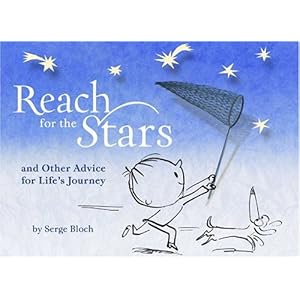
Reach for the Stars: and Other Advice for Life's Journey by Serge Bloch

Reach for the Stars: and Other Advice for Life's Journey
Bloch, S. – author (2010). Reach for the Stars: and Other Advice for Life's Journey. New York: Sterling. ISBN: 978-1402771293.

Annotation
A boy and his dog are given advice in the form of popular and inspirational quotes and euphemisms.

My thoughts
This is an inspirational book that explains the how to handle the good and the bad parts of life with quotes and euphemisms with humorous illustrations. The illustrations in this book make these sometimes weird sounding and popular figure of speech/euphemisms understandable. This is a good concept book for children and will assist in building an optimistic thought process.

The illustrations that incorporate photographs with ink drawings keep this book edgy and humorous.

Literary devices
Use of sayings:
You’re got your whole life ahead of you!
You won’t always be top dog. In fact, sometimes you’ll be in the doghouse.

Reading level/ Interest Age
Preschool and up.

Reviews and Awards
Serge Bloch has won a gold medal at the Society of Illustrators
Horn Book 2010

Author website: www.sergebloch.net
Media: pen and ink drawings with photography
Genre: juvenile picture book


Friday, June 22, 2012

Tell Me A Picture by Quentin Blake


Tell Me a Picture

Blake, Quentin - author. (2003). Tell Me A Picture. Brookfield, Conn.: Millbrook Press. ISBN: 978-1845076870.

Annotation
With Quentin Blake’s illustrated family, a collection of twenty-six paintings and drawings from the National Gallery in London is introduced to young readers.

My thoughts
Quentin Blake’s approach to introducing these famous works of art is to let children use their own eyes to create a narrative of their choosing. Then— turn the page to find the drawings of the young children who make their own sometimes humorous commentaries and off hand observations. This is an important technique. Many art books give descriptions that lose young readers right away. Quentin Blake’s method will encourage children to really look and question. In addition, seeing that there is no single right answer will give children confidence to voice their opinions. 

Curricular connections
Elementary art history/art appreciation

Reading level/ Interest Age
Kindergarten- grade 6

Reviews and Awards

Author website: www.quentinblake.com/
Media: ink, oil painting, ink and watercolor, etching, drawings
Genre: nonfiction, juvenile picture book